
Contents
AI datacenters need cooling because computation becomes heat
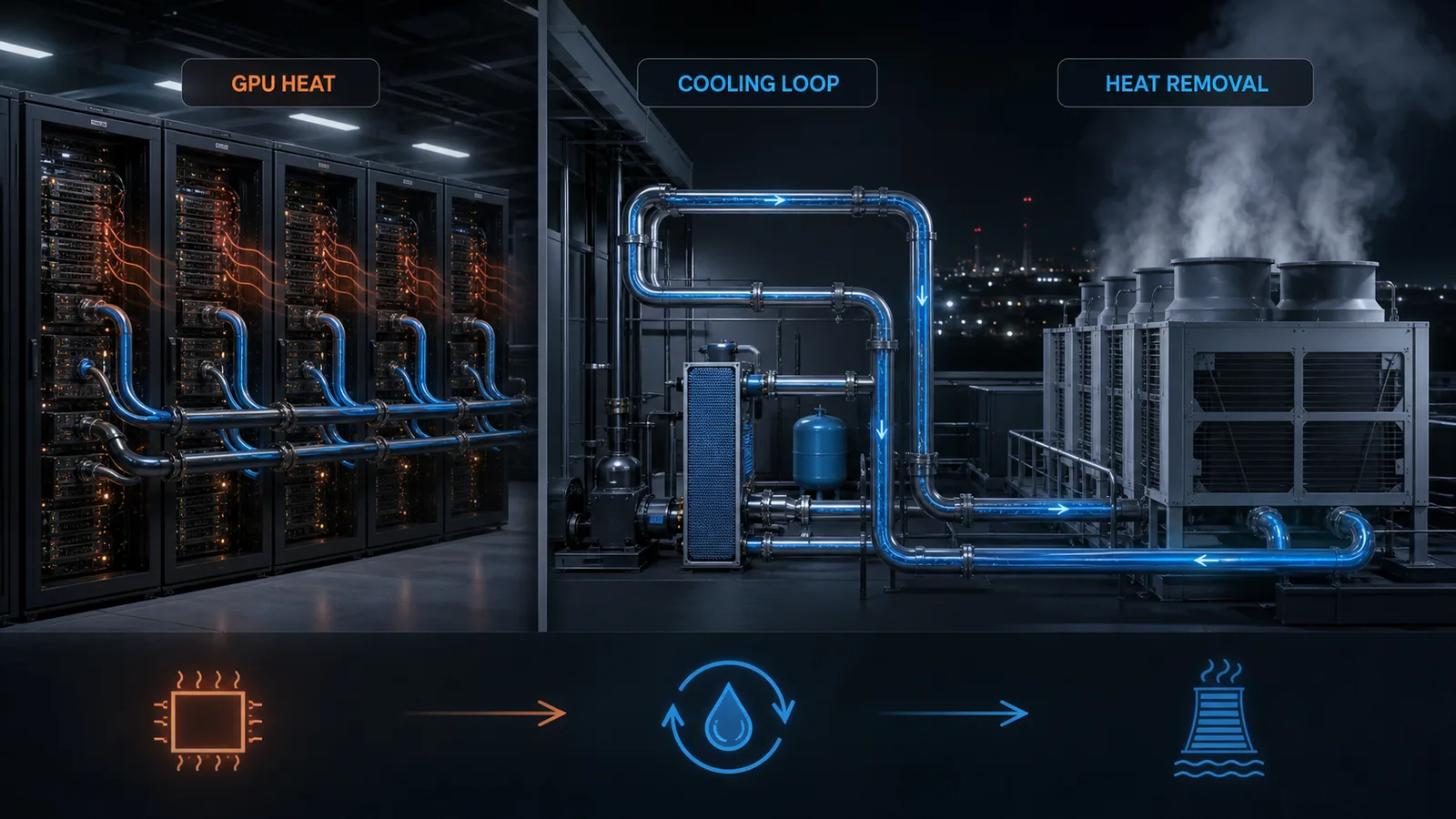
AI workloads run on physical machines. When GPUs, CPUs, memory, storage and networking equipment consume electricity, nearly all of that electrical energy eventually becomes heat inside the datacenter.
A conventional web server may handle lightweight requests, but AI training and inference can keep accelerators running at high utilization for long periods. Dense racks of GPUs concentrate much more heat in a smaller space than traditional enterprise IT equipment.
Cooling is therefore not an optional comfort system. It is part of the infrastructure required to keep chips within safe operating temperatures, avoid throttling, protect hardware and maintain reliable service for users.
GPU clusters make the cooling problem harder
Modern AI datacenters often group thousands of GPUs into clusters. Those GPUs are designed for parallel computation, which is why they are so useful for training neural networks and serving inference workloads.
The same density that makes AI infrastructure powerful also creates thermal pressure. More accelerators per rack means more power delivery, more networking, more memory and more heat to move away from the servers.
This is why AI datacenters are closely tied to both electricity and cooling capacity. A site may have enough land or fiber connectivity, but still be constrained by available power, heat rejection capacity or local water considerations.
How water-based cooling works
Water is useful in cooling because it can move heat efficiently. Many datacenters use chilled water loops, cooling towers, evaporative cooling or hybrid systems that combine air and water depending on outside conditions.
In an evaporative system, some water is intentionally evaporated to carry heat away. This can reduce the electricity needed for mechanical cooling, especially compared with running chillers heavily in warm conditions, but it can increase local water consumption.
Not every datacenter uses the same design. Some facilities rely more on air cooling, some use closed-loop liquid cooling near the chips, and some use reclaimed or non-potable water. The water footprint depends on the cooling architecture, climate and operating strategy.
Direct water use is only part of the picture
Direct water use means water consumed at the datacenter site, usually for cooling or humidity control. This is the most visible part of the issue, especially when a facility uses evaporative cooling in a water-stressed region.
Indirect water use can also matter. Electricity generation can require water for power plant cooling or fuel production, depending on the local grid. A datacenter that uses little water on site can still be linked to water use through the electricity it consumes.
This is one reason public estimates vary widely. A serious assessment needs to specify whether it counts on-site water, supply-chain water, electricity-related water, withdrawals, consumption, or all of those categories.
Location changes the real-world impact
A liter of water consumed in a cool, water-abundant region does not have the same local impact as a liter consumed in a hot, dry region with stressed watersheds. The same cooling technology can therefore have very different consequences depending on location.
Climate affects how often free cooling, evaporative cooling or mechanical chilling is used. Grid mix affects carbon emissions. Local water availability affects whether additional demand is minor, controversial or operationally difficult.
This is why datacenter sustainability cannot be reduced to a single global number. The relevant question is not only how much water is used, but where it is used, when it is used and what alternative cooling or power options were available.
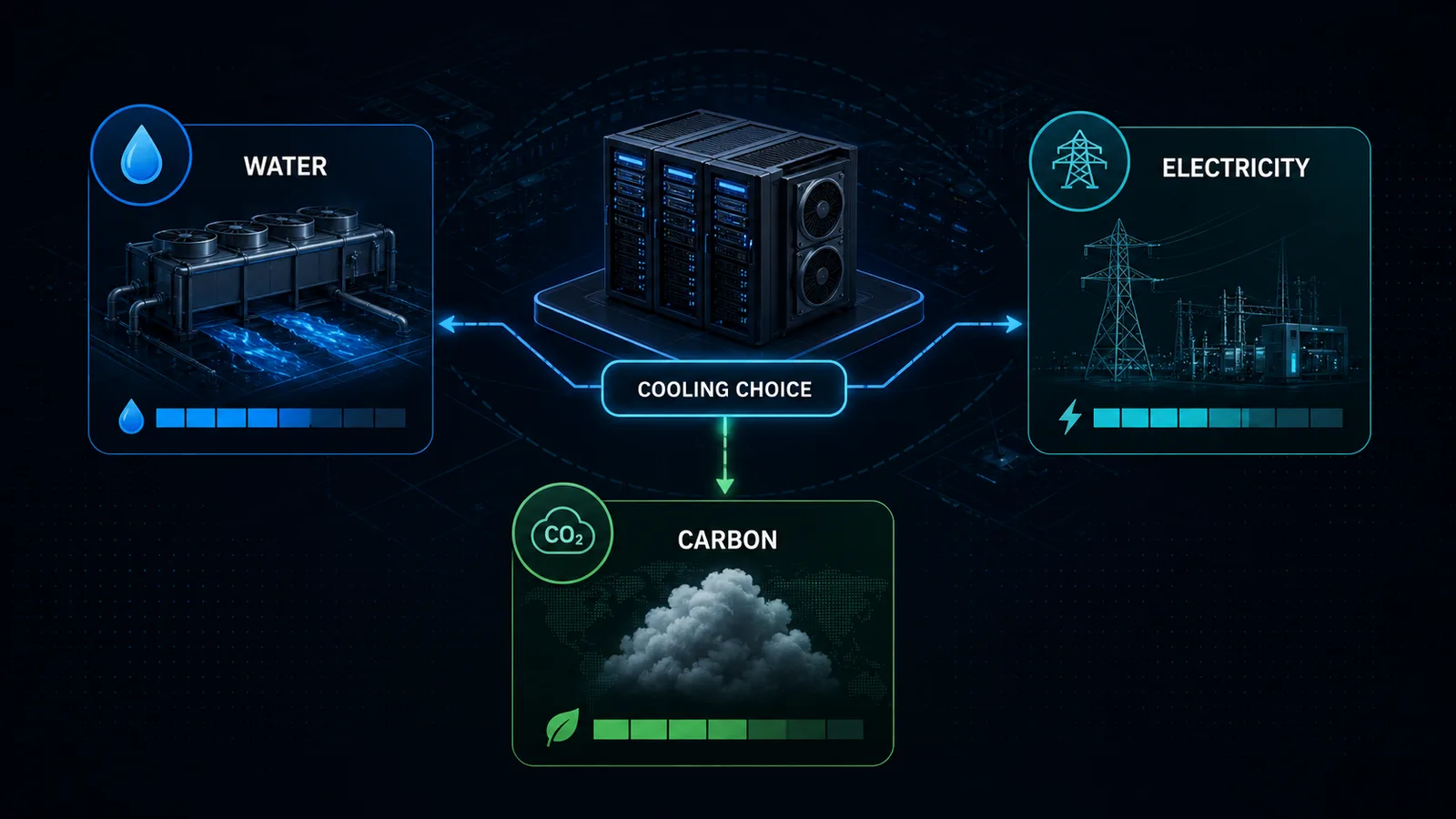
Water, electricity and carbon are connected
Reducing water use can sometimes increase electricity use. For example, a design that avoids evaporative cooling may rely more heavily on mechanical chillers, which can raise energy demand during hot periods.
The opposite can also happen: using water for evaporative cooling may reduce electricity consumption and therefore reduce emissions if the grid is carbon-intensive. The better option depends on local water stress, grid carbon intensity, weather and hardware density.
This is why transparent reporting matters. Metrics such as PUE for energy efficiency and WUE for water use are helpful, but they need local context. A low-water design is not automatically low-carbon, and a low-energy design is not automatically low-water.
Can AI datacenters use less water?
Yes, but there is no single universal fix. Options include better airflow management, warmer operating temperatures, closed-loop liquid cooling, dry coolers, reclaimed water, non-potable water, better siting decisions and more efficient AI hardware.
AI model optimization also matters. Smaller models, efficient inference, batching, caching and hardware specialization can reduce compute demand for a given service, which indirectly reduces heat and cooling requirements.
At the same time, total demand can still grow if AI usage expands faster than efficiency improves. The practical goal is therefore not only more efficient cooling, but better disclosure, careful site selection and infrastructure planning that accounts for local water stress.