
Contents
Inference is when an AI model is used
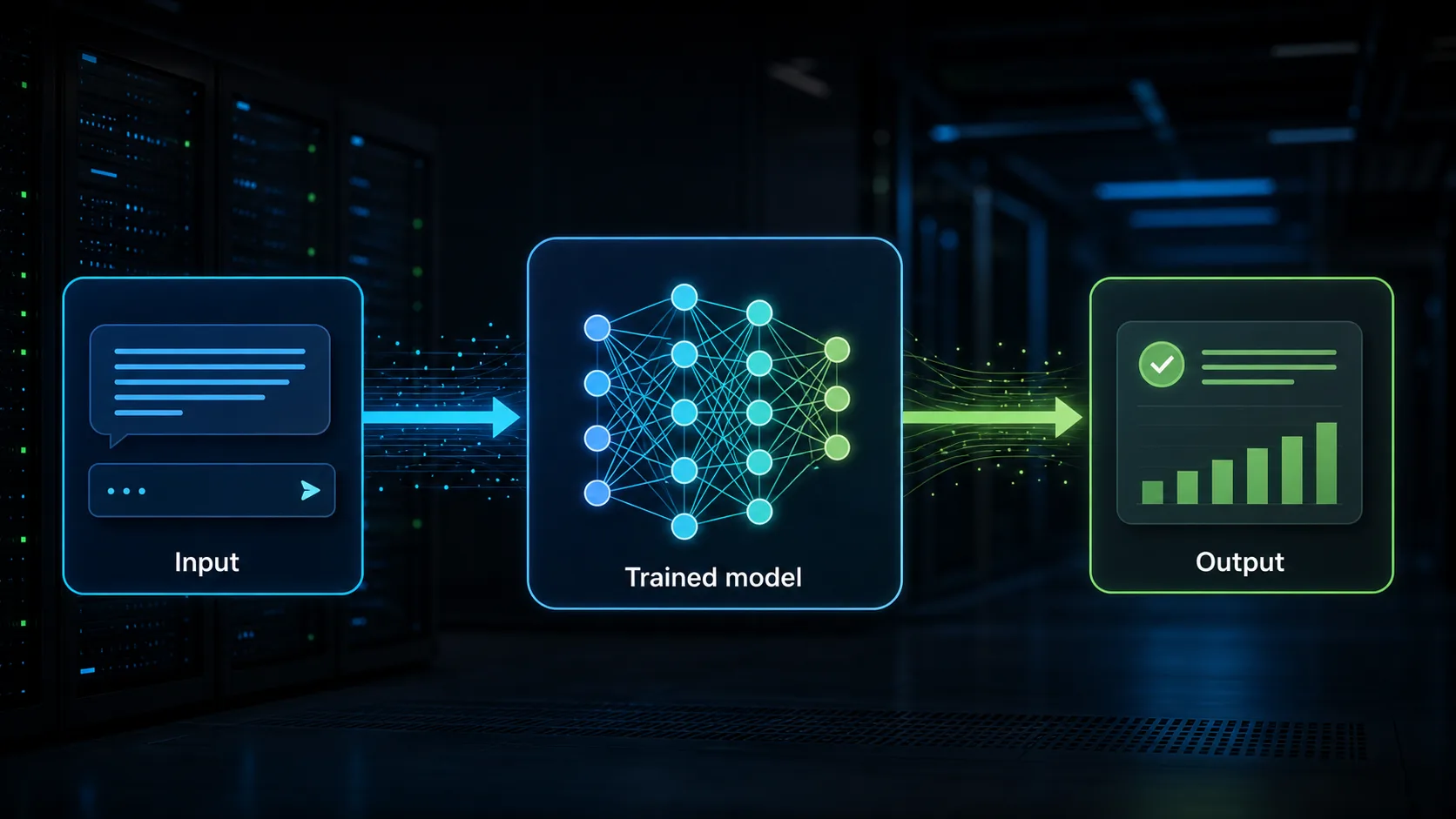
AI inference happens after a model has already been trained. A user, application or automated system sends a new input, and the trained model uses what it learned during training to produce a useful output.
That input might be a written prompt, a search query, a product image, a voice recording, a line of code or a row in a database. The output might be an answer, a generated image, a classification, a recommendation, a translation or a prediction.
This is why every ChatGPT response, AI image generation, search assistant result, recommendation engine and content moderation decision involves inference. The model is not being rebuilt each time. It is being run on new data.
Training builds the model, inference runs it
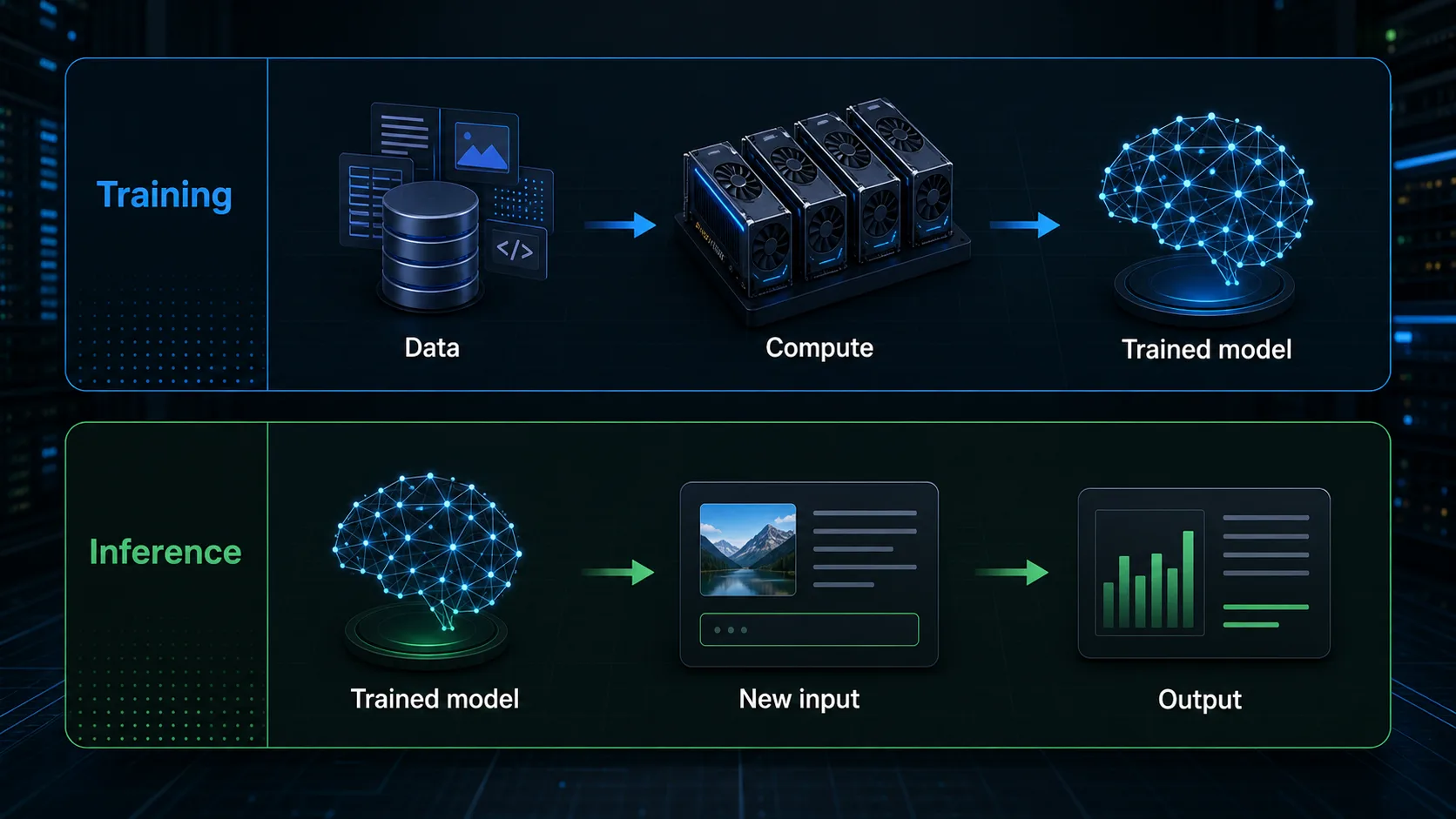
Training and inference are two different phases of the same AI system. Training creates or updates the model by processing large datasets, comparing predictions with examples and adjusting internal parameters over many repeated steps.
Inference starts after that training work has produced a usable model. The trained model is deployed on servers, receives new inputs and applies its learned patterns without going through the full training process again.
A simple way to remember the difference is this: training is how the model learns, while inference is how the model is used. For a deeper explanation of the first phase, see the guide on how AI models are trained.
What happens during AI inference?
The exact steps depend on the type of model, but the basic flow is similar. An input arrives, the system prepares it in the format the model expects, the model performs computation across its parameters, and the system turns the model output into something the user can read, view or use.
For a language model, a prompt is usually split into tokens. The model evaluates those tokens and predicts likely next tokens one step at a time. For an image model, the input may be text, an image or both, and the model gradually produces pixels or visual features that match the request.
Other systems may classify a document, rank search results, detect objects in an image, transcribe speech or recommend a product. In each case, inference is the live execution step that transforms a new input into a model output.
Why inference needs compute
AI inference is not a simple lookup in a database. A large model may contain billions of parameters, and using it requires many mathematical operations to move information through the model and calculate the next output.
This computation must often happen quickly. A chatbot answer, search assistant response or real-time translation should arrive in seconds or less, so inference systems care about latency, memory bandwidth, batching, model size and hardware utilization.
GPUs and other AI accelerators are useful because they can perform many parallel operations efficiently. The larger the model, the longer the context and the more simultaneous users there are, the more carefully inference infrastructure has to be designed.
Examples of inference in everyday AI
When a chatbot answers a question, it is performing inference. The same is true when an image generator creates a picture from a prompt, a coding assistant suggests a function, or a translation tool converts a sentence into another language.
Inference also appears in less visible systems. A recommendation feed ranking videos, a fraud detection system flagging a transaction, a medical imaging model highlighting a region of interest or a factory vision system detecting defects all use trained models on new data.
These examples look different to users, but they share the same basic pattern: a trained model receives an input, performs computation and returns an output that supports a decision, answer or generated result.
Why inference matters for energy and infrastructure
One inference request can be small, but modern AI systems operate at huge scale. Millions or billions of prompts, image requests, recommendations and API calls can create continuous demand across GPUs, networking, storage and cooling systems.
This is why inference is central to AI infrastructure. Training may be the most visible compute event, but inference is repeated every time people use deployed AI tools. At global scale, that repeated usage can become a major driver of GPU demand and datacenter electricity use.
The exact energy cost of one AI query depends on model size, hardware, batching, utilization, datacenter efficiency and the type of output. The important point is that inference connects everyday AI usage to physical infrastructure: chips, servers, power, cooling and datacenters.
How inference is optimized
AI providers spend a lot of engineering effort making inference faster, cheaper and more efficient. Batching can process multiple requests together, caching can reuse repeated work, and routing can send simpler tasks to smaller or specialized models.
Other techniques reduce the amount of computation required. Quantization can represent model values more compactly, distillation can transfer behavior into a smaller model, and pruning or architecture changes can remove unnecessary work while preserving useful quality.
Specialized hardware also matters. GPUs, AI accelerators, fast networking and high-bandwidth memory help deployed models respond reliably at scale. Better inference efficiency can reduce latency, cost and electricity use, but it does not make infrastructure disappear.